
The Human Brain
The Human Brain
Why understanding the brain matters
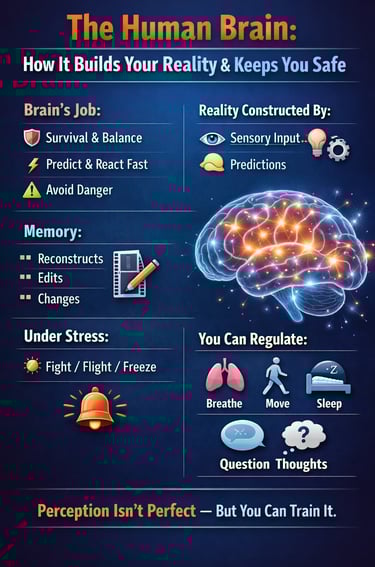
Your brain isn’t designed primarily for “perfect truth,” but for survival and adaptation. That’s good news: many reactions—fear, urgency, anxiety, impulsive habits—are not character flaws. They’re automatic protection mechanisms.
When you understand how they work, you gain clarity—not because you become perfect, but because you become more aware of what’s happening inside you.The brain’s primary function: survival and internal balance
The brain’s main job is to keep you alive and stable (homeostasis). It:
• regulates temperature, energy, hunger, thirst, and stress
• anticipates and avoids danger
• makes fast decisions through senses, memory, and learning
Many “higher” functions—thinking, emotion, consciousness, personality—are largely extensions of this core purpose.The brain doesn’t “see” reality—it constructs it
The brain is not a camera. It builds reality from:
• sensory input (what you see, hear, feel)
• predictions (expectations, habits, learned models)
It “guesses” quickly, then corrects based on incoming data. That’s why:
• people interpret the same event differently
• emotions can feel absolutely certain
• perception can be convincing without being perfectly accurateWhy it works this way: speed and energy efficiency
The brain must be fast. Analysing everything from scratch would be too slow in critical moments. Prediction saves time and energy.
Key point: the brain often prefers perceived safety over perfect accuracy.Optical illusions: proof of prediction-based perception
Illusions show how the brain fills in gaps and chooses the most likely meaning when information is unclear.Your “reality” is shaped by your body state
Your lived experience is influenced by:
• body tension
• fatigue
• energy and nutrition
• activated memories
• social context
The same event can feel entirely different depending on your physical state.Memory is reconstruction, not a perfect archive
Memory works like a video editor:
• cutting and stitching
• filling in gaps
• emotionally colouring details
Remembering is rebuilding. That’s why vivid memories aren’t always perfectly accurate.Emotions are action signals, not verdicts.
Emotion means: “this matters.” But it does not automatically prove:
• real danger
• bad intentions in others
• that you are “right”
Sometimes emotions are accurate; sometimes they’re old alarms triggered by small cues.Anxiety and trauma: when predictions skew toward threat
Anxiety often reflects threat overestimation—your body reacts as if danger is already present.
Trauma can train the alarm system to fire quickly in response to learned cues (tone, smell, place, context), even when the present is safe.The autonomic nervous system: what runs you under stress
A lot is automatic (fight/flight/freeze). Reason may come later.
Two broad modes:
• Safety: calm, connection, digestion, creativity
• Threat: narrowed attention, danger scanning, simplified thinking, reduced empathy
That’s why logic is difficult when stress is high.The brain is social
It’s built to read facial expressions, tone, intention, and signals of belonging. Rejection can hurt physically; validation can calm the body.Attention is the brain’s currency.
What you repeatedly focus on becomes “important.” Daily exposure to negativity and comparison trains threat-based predictions. Nature, movement, sleep, and supportive relationships train safety.Dopamine: motivation and seeking
Dopamine is more about wanting and seeking than pure pleasure—explaining compulsive chasing and micro-reward habits.Learning: repetition + emotion
Repetition builds ease. Strong emotion makes memories stick—especially fear.Sleep: brain maintenance
Sleep regulates emotions, consolidates memory, and reduces reactivity. Poor sleep increases irritability, impulsivity, and anxiety.Neuroplasticity: you can change with consistency
The brain rewires throughout life. Small daily shifts beat big rare efforts. The environment often beats willpower.
6 simple tools for regulation (daily)
“My mind predicts that…”
“What evidence do I have right now?”
10 slow breaths (longer exhale).
Natural light + 5 minutes of movement.
Protect basics: sleep, food, hydration.
Gentle repetition: a little daily, not perfect.
Note on spiritual experiences and “life after death”
Deep inner experiences can be extremely convincing and are often interpreted spiritually. From a scientific perspective, there is no consensus that consciousness survives bodily death. This doesn’t prove such beliefs are false—only that we lack verifiable confirmation.
Disclaimer: This article is for educational purposes and does not replace medical or psychological advice. If you experience severe symptoms, seek professional support.
Contact Us
If you would like to get in touch, you are welcome to do so.
Please include:
a brief introduction
what you are looking for
any relevant context
Messages are read carefully, but replies may take time.
Quality attention matters more than speed.
Use the contact form below, or reach out via the provided details.